Category Analysis: Maple Syrup
As consumers seek natural sweeteners and clean labels, the maple syrup category is finding new opportunities beyond the breakfast table.
Steven Anderson, President of Anderson’s Maple Syrup, summed up the major challenges and opportunities facing the category. “Demands by retailers asking to drive more to their bottom line without losing ours. Opportunity to show the retailer how well syrup can sell if they don’t over price us.”
He continued, “On the positive side, our product is gaining in popularity because it is natural and a great-tasting sweetener that is also better for your body than most others. On the downside, consumers are being cautious of how they spend their money. Pure maple syrup is not the lowest-cost syrup on the shelf.”
Emma Marvin, Co-CEO of Butternut Mountain Farm, reported on one of the hurdles she sees for the category.
“One of the biggest challenges right now is balancing the economics of a premium agricultural product with a consumer environment where value is under a microscope. We have to think about value all the way through the chain; from the producers who make the syrup to our customers and ultimately the consumer. At the same time, that creates an opportunity to be more thoughtful about pack sizes, price points, channels and how we communicate what makes pure maple worth choosing,” noted Marvin.
On the plus side, expansion of use continues to be an opportunity for the category.
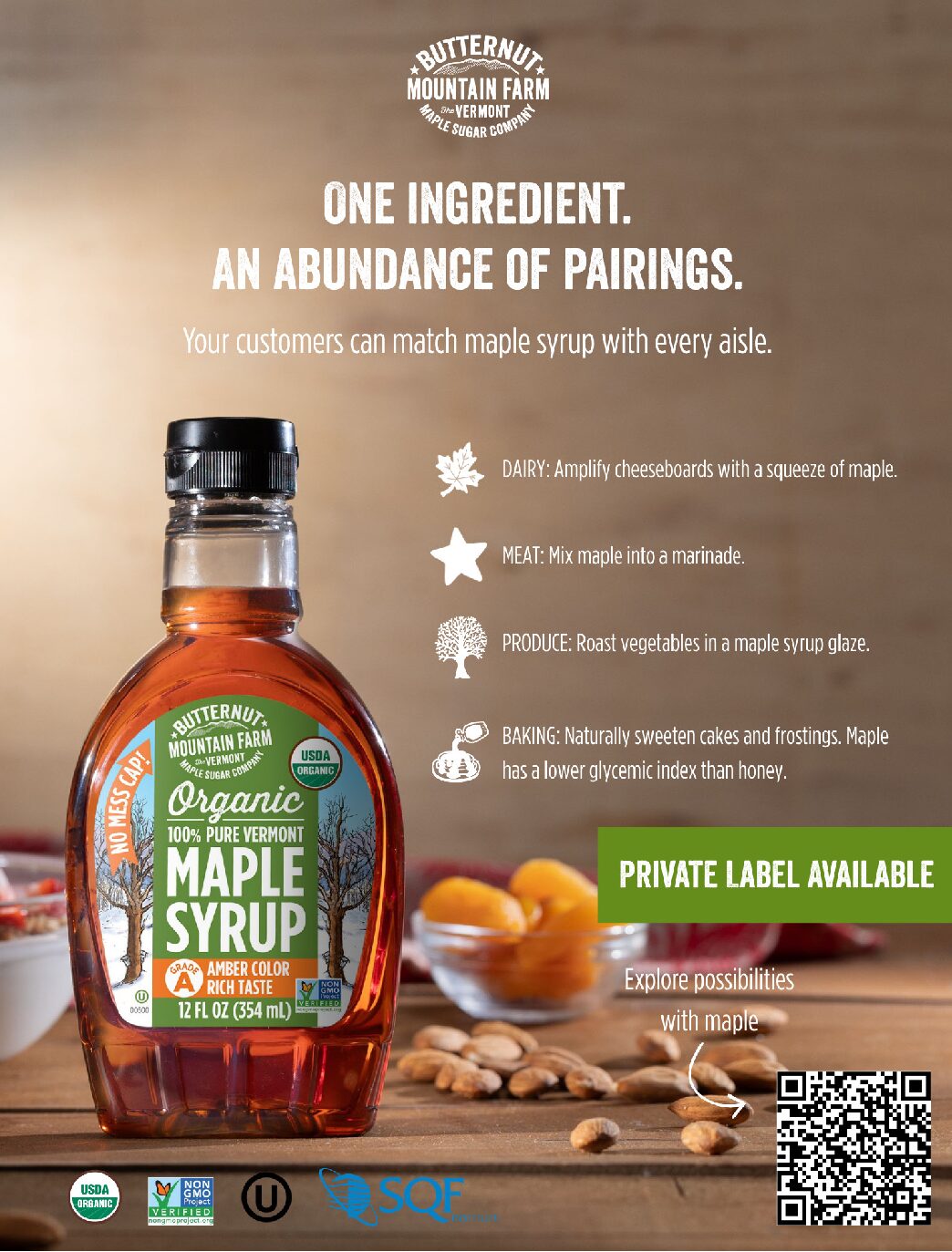
Arnold Coombs, Director of Sales & Marketing at Coombs Family Farms, previously reported, “Maple is being used more and more as an ingredient and that’s where growth is coming from. It’s not just for pancakes. It’s for baking. It’s for barbecue sauces and marinades. And that’s where our marketing is heading.”
Quality and safety precautions are strict and serious at every step of the maple syrup process.
“Quality and safety are [one and] the same to us. We have strict guidelines in place to make sure we don’t contaminate our syrup with anything, and no one is allowed into our packaging and processing areas without a hairnet, clean hands and clean clothes, and training. We treat the syrup with as much respect as we would our grandmother. We also package our syrup at over 200°F—this is a good 15 to 20 degrees hotter than most. It does two things for us: it makes the syrup taste fresh longer, and it adds safety to our final product, as that extra 15-plus degrees does an even better job of sterilizing the container and making the syrup safe for a long time.”
“Safety and quality are a fundamental part of how we operate at Butternut Mountain Farm, beginning with the syrup we source from maple producers. Maple syrup is evaluated and tracked, with controls in place throughout processing and packaging to ensure the product is safe, consistent, and meets our standards. That work is supported by our SQF level 2-certified food safety system, which recently received an ‘Excellent’ audit rating. Ultimately, though, food safety and quality go beyond any one system or audit. It’s about building a culture where people across the organization understand that we all have a role to play,” relayed Marvin.
The category is well suited for health-conscious consumers.
“Consumers are paying closer attention not only to how much sugar they consume, but to what kind of sweetener they are choosing. Pure maple syrup has a very simple story: one ingredient, minimally processed, with a distinctive flavor and a direct connection to where it comes from,” confirmed Marvin from Butternut Mountain Farm.
“As people trend towards healthier lifestyles, maple syrup is a great balance for nearly every recipe. I see a lot of growth in home cooking but also in the prepared foods that people are buying at the grocery store, online or in a restaurant. Maple is everywhere and that will continue to grow,” said Anderson of Anderson’s Maple Syrup.
To reach those consumers, Anderson’s Maple Syrup has been focusing efforts online.
“We are leaning more and more on social media over conventional advertising. We also like events where we get a chance to be face-to-face with our customers and make that personal connection. It is all about that personal connection, and if you can’t get it in person, social media seems to be the second best.”
“We are trying to appeal to the younger demographic with our social media. Younger consumers are living healthier lives and want healthier diets. They care about where things come from,” Coombs explained previously. “We are also evolving to be a better vendor to our clients and target promotions to move more product off the shelf for retailers.”
If there were one message Anderson would like to relay to consumers, it would be: “Make sure you are buying pure maple syrup that is made in the USA and support our growing industry. The US is making a lot of syrup, but we still have a long way to go to catch up to our northern neighbors. Your dollars help decide where your syrup is coming from.”
For Butternut Mountain Farm, encouraging consumers to think beyond the bottle is an important message: “This is an industry that has a transformational impact on rural communities across Eastern North America, that supports working forests, family businesses, jobs and agricultural economies. There is so much contained in that bottle beyond the syrup itself.”