Category Analysis: Private Label Merchandising
Manufacturers are becoming more strategic, not reactive, as private label and the broader grocery industry evolve. Private label products have changed from simple shelf fillers into sought-after ingredients and meals.
“Consumers came for the value and stayed for the quality,” said Renee Hicks, Director of Private Brands for The Fremont Company. “Retailers are also treating their store brands as true strategic assets now, not just margin fillers—and that investment creates real opportunity for a manufacturing partner like Fremont. Categories like sauces and condiments have seen strong private label penetration.”
“The biggest driver is the shift in consumer perception of private label is no longer seen as a trade-down,” Larry Page, Vice President of Marketing & Product Development at Premier Brands of America pointed out. “In many categories, penetration is now above 20 percent and growing faster than national brands. Retailers are investing more in quality, branding, and innovation, and we’re helping deliver products that match or exceed expectations while maintaining strong value and solid contribution margins.”
Demand for private label extends beyond the shelf-stable aisles. “The refrigerated and frozen sections have evolved well beyond basic staples and remain among the strongest performing areas for store brands,” said Tom Prendergast, Director, Research Services, for the Private Label Manufacturers Association (PLMA). “Retailers continue to broaden their private label assortments with chef-inspired meals, globally influenced flavors, and convenient options designed for busy households.”
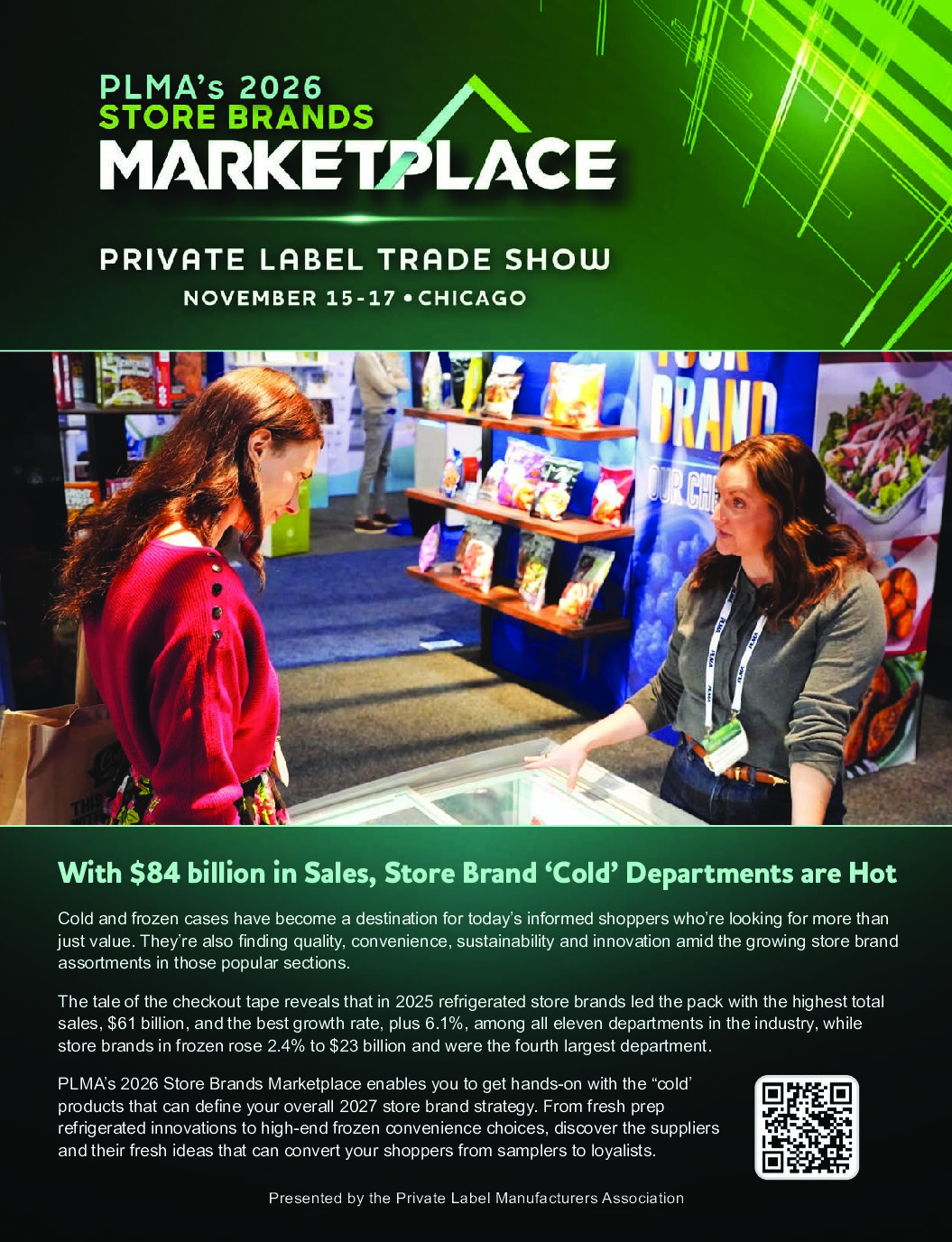
Prendergast continued, “According to PLMA’s 2026 Private Label Report, refrigerated store brands generated $61 billion in sales in 2025, the highest total among all 11 of the departments tracked by Circana for PLMA, and the one with the fastest growth rate at +6.1 percent. Frozen store brands ranked as the fourth-largest department, reaching $23 billion in sales, an increase of 2.4 percent. Combined, store brands accounted for $84 billion in sales.”
Retailers are responding to this improved perception. Jenny Longo, VP of Private Brands for Longo Brothers, agrees: “Private label brands are no longer viewed as lower-tier or lower-quality alternatives. They have evolved into high-quality, innovative, and trusted options that increasingly compete with—and in some cases surpass—national brands. Today’s private label programs focus on quality, innovation, and differentiation. At Longo’s, we hold ourselves to a high standard: if we wouldn’t serve it to our own families, it’s not good enough for our private label program.”
Companies like Massimo Zanetti Beverage (MZB) are listening—both to consumers and retailers. President Matthew Smith reported, “We’re focused on: understanding evolving value expectations, especially around quality, flavor, and format; staying close to how shoppers navigate the coffee aisle today; and working with retailers earlier in the planning process to anticipate where categories are going, not just where they’ve been. Because we operate across branded and private label, we have a unique vantage point into how consumer behaviors are shifting in real time, and that allows us to respond with relevance, not reaction.”
Shoppers also trust that store brands meet quality and safety standards for their beloved pets. “Rising sales are a clear indicator that pet parents are increasingly turning to private label for the care and feeding of their animal companions,” Dan Weil, Senior Director, Chicago Trade Show for the PLMA. “As a result, savvy retailers across the country with comprehensive store brand programs are enjoying the ride.”
“On the strength of robust growth and climbing market share, 2025 was a good one for private label pet products,” Weil continued. “When it came to increases in private label unit and dollar sales throughout the store, the pet care department was clearly among the best performing food and nonfood sections during the year, according to FY data from Circana provided to PLMA. Pet care department gains in both private label unit sales (plus 5.4 percent) and dollar sales (plus 3.7 percent) well exceeded the record-setting advances experienced by the overall US store brands industry last year. Pet care private label unit sales came in at one billion while dollar sales were at $5.6 billion, both all-time records.”
Private label manufacturers’ priorities are evolving. “Our focus has sharpened around being more proactive with retail partners and getting ahead of their planning cycles earlier,” said Hicks. “Cost pressures haven’t gone away, so operational efficiency across our dry goods lines remains a priority—but the bigger shift is moving from reactive to strategic in how we show up for our customers.”
“We view ourselves as a category consultant, not just a supplier. We help retailers bridge the gap between a consumer trend and a physical product on the shelf,” replied Smith with MZB. “This involves sharing deep category insights, navigating the realities of manufacturing, and balancing ‘newness’ with operational feasibility.”
“The environment has definitely shifted, with consumers becoming more value-conscious as economic pressure builds,” said Page. “That said, our core strategy hasn’t changed. We’ve always focused on delivering products that truly meet consumer and customer needs while providing strong value. What has evolved is our emphasis on sharper execution, prioritizing high-velocity items and staying closely aligned with how retailers are responding to these shifts.”